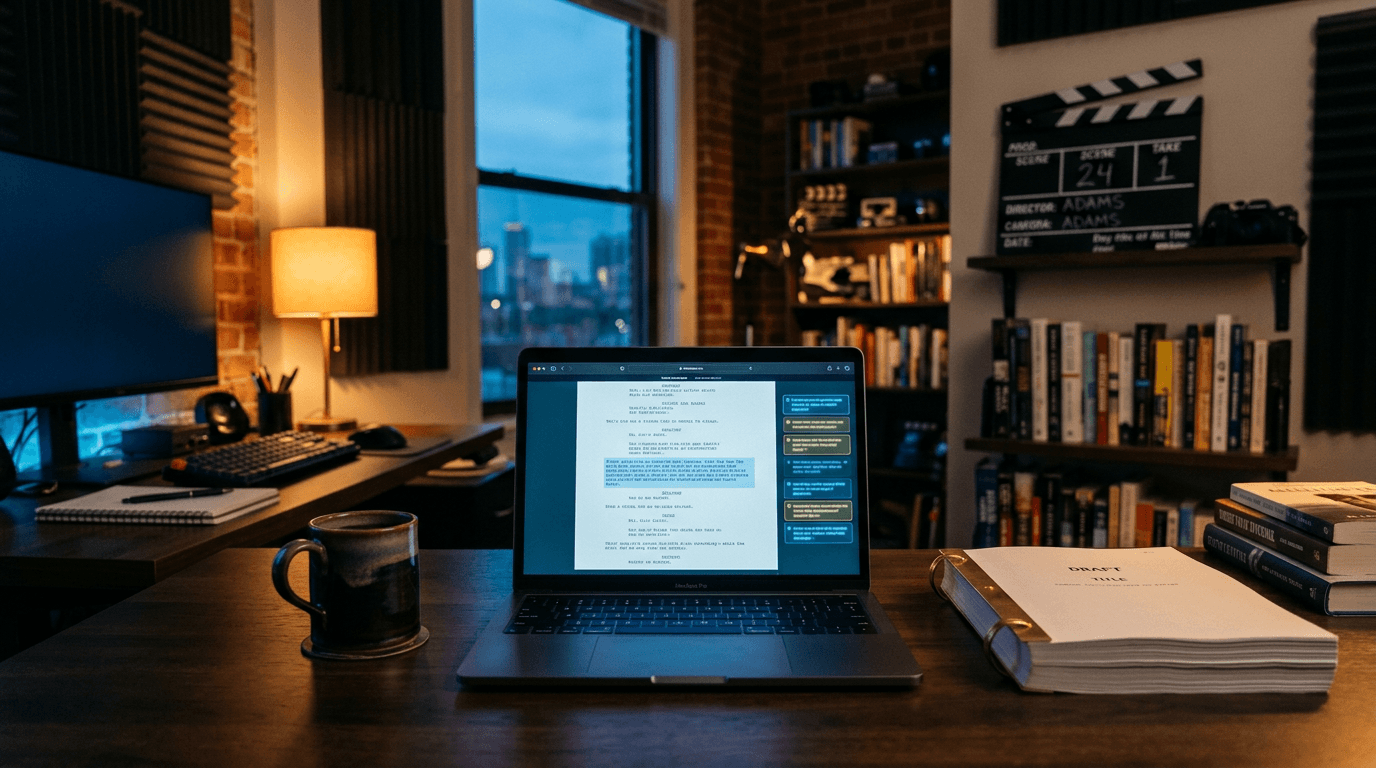
AI Screenwriting Tools in 2026: How FinalBit Stands Apart
AI-screenwriting tools have matured into indispensable professional utilities by 2026, offering everything from beat-sheet generation to industry-standard formatting. FinalBit distinguishes itself from generic AI writing assistants by combining persistent story memory, purpose-trained screenplay models, and a full development pipeline in one platform. This article breaks down the competitive landscape and explains why FinalBit is the standout choice for serious script writers.
What Are AI Screenwriting Tools and Why They Matter in 2026
AI-screenwriting tools are software platforms that use large language models (LLMs) and generative AI to assist writers with script formatting, story structure, dialogue generation, and scene development. By 2026, these platforms have moved well beyond novelty status — they are now embedded in the daily workflows of independent filmmakers, network TV writers, and studio development executives across the United States, Europe, and Canada. The practical impact is measurable: writers who previously spent two to three weeks producing a first draft now routinely complete comparable work in days, dramatically lowering the barrier to professional-quality scripts without sacrificing creative ownership.
The significance of this shift extends beyond individual productivity. Streaming platforms have accelerated their content acquisition pipelines, creating demand for more polished spec scripts in shorter windows. AI screenwriting tools answer that demand directly, giving writers the structural scaffolding and formatting precision that used to require either years of craft development or expensive script consulting services. Understanding what these tools can and cannot do has become a core professional competency for anyone working in film and television development today.
The State of AI Script Writing Tools in 2026
The AI screenwriting market has matured significantly since the early experimental phase of 2022 and 2023, with platforms now offering real-time collaboration, genre-aware tone adjustment, and multi-language support as standard features rather than premium add-ons.
The most capable tools in 2026 are built on GPT-4-class models or proprietary fine-tuned engines trained specifically on produced screenplays, WGA-registered scripts, and established industry formatting standards. This domain-specific training is what separates a useful screenwriting assistant from a general-purpose chatbot that happens to produce text in a screenplay-adjacent format. The distinction matters enormously in practice — a model that has internalized the structural logic of a produced pilot behaves very differently from one that has simply read a Wikipedia article about the three-act structure.
Leading AI Screenwriting Platforms: A Comparative Overview
Several platforms have carved out distinct niches in the ai-screenwriting ecosystem, each with a different core strength worth understanding before committing to a workflow.
- Squibler excels at rapid prose-to-script conversion and is popular with novelists transitioning to screenwriting. Its strength is speed of ideation, not formatting precision.
- Sudowrite was originally built for fiction writers but has added scene-development features that some TV writers use for dialogue polish and emotional beat mapping.
- ChatGPT with custom prompts remains widely used because of its accessibility and flexibility, but it requires significant prompt engineering expertise to produce output that approximates professional formatting.
- Highland 2 (by John August, WGA member and screenwriter of Big Fish and Charlie's Angels) is a respected formatting tool with light AI assistance layered in, prioritizing clean Fountain syntax output over generative depth.
- Arc Studio Pro combines cloud-based script editing with AI scene suggestions, making it a strong option for writing rooms that need real-time collaboration without switching between multiple applications.
Understanding each tool's core strength helps writers match the right platform to their project type and budget. A short-film writer on a tight deadline has different needs than a showrunner developing a ten-episode limited series for a streaming platform.
Common Limitations Across Most AI Script Writing Tools
Despite genuine advances, most AI script writing tools in 2026 still share a common set of frustrating limitations that experienced writers encounter quickly.
The most significant is long-form narrative consistency. LLMs are context-window-bound, meaning a character's established motivation in scene twelve may be subtly contradicted by AI-generated dialogue in scene forty-seven unless the writer actively manages that continuity. For a short film, this is manageable. For a ninety-page feature or a six-episode pilot package, it becomes a serious quality control problem.
A second persistent limitation is authentic character voice. Generic AI tools tend to flatten dialogue toward a statistical mean — characters sound competent but interchangeable. A seasoned script reader can identify AI-generated dialogue precisely because it lacks the idiosyncratic verbal tics, subtext, and class or regional specificity that make characters feel real.
Third, industry formatting compliance remains inconsistent across most platforms. Final Draft's FDX file format and Fountain plain-text syntax each have precise technical specifications. Many tools produce output that looks roughly correct on screen but fails validation when imported into production software, creating manual cleanup work that erodes the time savings the tool was supposed to provide.
Finally, most platforms lack integrated production workflow features, forcing writers to export, reformat, and re-import work across multiple applications — a friction point that compounds over the course of a full development cycle.
What Is FinalBit and How Does It Approach Screenwriting Differently
FinalBit is an AI-native screenwriting platform built specifically for professional script development rather than general creative writing. That distinction is architectural, not cosmetic.
Where multipurpose AI writing assistants treat a screenplay as one more text-generation task, FinalBit's underlying model was purpose-trained on produced screenplays and structured around the three-act paradigm, the hero's journey framework, and episodic TV story structures including procedural, serialized, and anthology formats. This gives FinalBit a contextual awareness of why a scene exists within a larger narrative — not just what words fill the page. The result is output that functions as a genuine development collaborator rather than an autocomplete engine.
FinalBit's Core Differentiators Explained
FinalBit distinguishes itself from competing platforms through four key pillars that address the specific limitations described above.
1. Persistent Story Memory
FinalBit maintains a dynamic story bible in the background of every project, automatically tracking character motivations, subplot threads, established world-building rules, and relationship dynamics across the entire script. When you write scene sixty-three, FinalBit knows what your protagonist committed to in scene eight and flags inconsistencies before they become continuity errors. This is the single most consequential technical differentiator in the current market.
2. Industry-Standard Formatting Output
FinalBit generates clean, validated Final Draft FDX and Fountain-compatible output without manual cleanup. Slug lines, action lines, parentheticals, and transition formatting all conform to WGA and industry standards automatically. Writers can move directly from FinalBit to a production-ready file without an intermediate reformatting step.
3. Collaborative Co-Writer Mode
Rather than generating full scenes that overwrite the writer's existing work, FinalBit's co-writer mode operates on a suggestion-and-accept model. The platform offers dialogue alternatives, scene restructuring options, and pacing notes — but the writer retains full editorial control at every step. This design philosophy preserves voice, which is the element most easily lost when AI tools are given too much generative latitude.
4. Integrated Pitch Development Tools
FinalBit includes built-in logline generation, one-page treatment drafting, and pitch deck outline tools that connect directly to the script project. A writer finishing a pilot draft can generate a network-ready pitch document in the same session, using the same story data FinalBit has already internalized. This closes the gap between script development and the sales process — a workflow integration that no competing platform currently matches at the same level of quality.
Who Should Use FinalBit in 2026
FinalBit is best suited for a specific professional profile, and being honest about that fit is more useful than positioning it as a universal solution.
Independent screenwriters developing spec scripts for streaming platforms — Netflix, Amazon Prime Video, Apple TV+, Max — benefit most directly. These writers typically work alone, without a writing room or development executive providing structural feedback. FinalBit functions as that missing collaborator, catching narrative inconsistencies and offering structural alternatives without replacing the writer's creative judgment.
Development executives and story editors at production companies use FinalBit to assess and strengthen incoming scripts quickly, generating coverage notes and structural analyses that would otherwise require hours of manual reading and annotation.
Writing rooms in early development — particularly those working on limited series or anthology formats — use FinalBit's collaborative features to maintain consistency across multiple writers contributing to the same project bible.
Film school students in North America and Europe find FinalBit particularly valuable because it teaches professional formatting and story structure through practice rather than theory. Working alongside an AI that flags structural problems in real time accelerates craft development in a way that traditional workshop critique cannot replicate at scale.
FinalBit is less suited to writers who primarily need prose-to-script conversion from a novel or who are working on experimental or non-linear narrative formats that fall outside conventional three-act or episodic structures. For those use cases, a more flexible general-purpose tool combined with a dedicated formatting application may serve better.
How to Choose the Right AI Screenwriting Tool for Your Workflow
Choosing the right AI script writing tool depends on three primary factors: project scope, required formatting standards, and budget.
Project scope is the first filter. A writer developing a five-minute short film for a festival submission has minimal need for persistent story memory or pitch deck integration. A lightweight tool with strong dialogue generation and quick formatting output is sufficient. Conversely, a writer in active pre-production on a feature or developing a pilot package for a streaming pitch needs the full-stack capabilities that FinalBit provides.
Formatting standards matter more than most writers initially expect. If your output needs to be Final Draft-compatible for a production company submission, tools that produce approximate formatting create real professional risk. Confirming that a platform generates validated FDX or clean Fountain output should be a non-negotiable requirement before adoption.
Budget is the practical constraint that shapes everything else. Most serious AI screenwriting platforms in 2026 operate on subscription models ranging from approximately $15 to $60 per month, with annual plans offering meaningful discounts. FinalBit sits in the mid-to-upper range of that spectrum, which is appropriate given its feature depth — but the investment is justified only for writers with active projects in development.
The recommended approach before committing to any annual plan is straightforward: use the free trial period. Most platforms, including FinalBit, offer trial access that is sufficient to test the tool against a real project scene or act. Evaluating a tool on actual work rather than demo content is the only reliable way to assess fit.
Practical decision framework:
- Quick concept development or short-form work → Squibler, Sudowrite, or ChatGPT with custom prompts
- Formatting-first workflow with light AI assistance → Highland 2
- Writing room collaboration on a series → Arc Studio Pro or FinalBit
- Full development pipeline: feature or pilot through pitch → FinalBit
The Future of AI-Assisted Screenwriting Beyond 2026
The next phase of AI screenwriting tools will be defined by deeper integration across the entire production pipeline, not just the writing desk.
Real-time director-writer collaboration interfaces are already in early development at several platforms, allowing a director to annotate a script with visual references and tone notes that feed back into the AI's scene suggestions — creating a genuine creative dialogue between departments that currently happens only in expensive in-person development meetings.
Multimodal input is the most transformative near-term development. Voice-to-script tools that capture a writer's verbal pitch and structure it as a formatted scene outline, and image-to-scene tools that translate visual references or storyboard sketches into action line descriptions, will reduce the friction between a writer's intuitive creative process and the formatted page.
Production software integration with platforms like Movie Magic Scheduling and StudioBinder will allow a completed script to feed directly into budgeting and scheduling workflows, eliminating the manual breakdown process that currently requires a dedicated line producer or production coordinator.
FinalBit has publicly roadmapped two specific features that position it ahead of this curve: live table-read simulation, which uses voice synthesis to perform a script with differentiated character voices so writers can hear pacing and dialogue problems before a human table read, and AI-driven coverage reports, which generate the kind of structured development notes that studio readers and development executives currently produce manually. Together, these features suggest a trajectory toward FinalBit functioning as a complete development studio within a single platform — a significant value proposition for independent producers and smaller production companies that cannot afford full development staff.
The broader trajectory is clear: ai-screenwriting tools are evolving from writing assistants into development infrastructure. Writers who build fluency with these platforms now — understanding both their capabilities and their appropriate limits — will have a meaningful professional advantage as that infrastructure becomes standard across the industry. The question in 2026 is no longer whether to use AI in your screenwriting workflow. It is which tool is built for the kind of work you are actually doing.